
NAVIGATING THE NEW GLOBAL ORDER: THROUGH THE LENS OF PUBLIC INTERNATIONAL LAW
Home » NAVIGATING THE NEW GLOBAL ORDER: THROUGH THE LENS OF PUBLIC INTERNATIONAL LAW
MTSPL
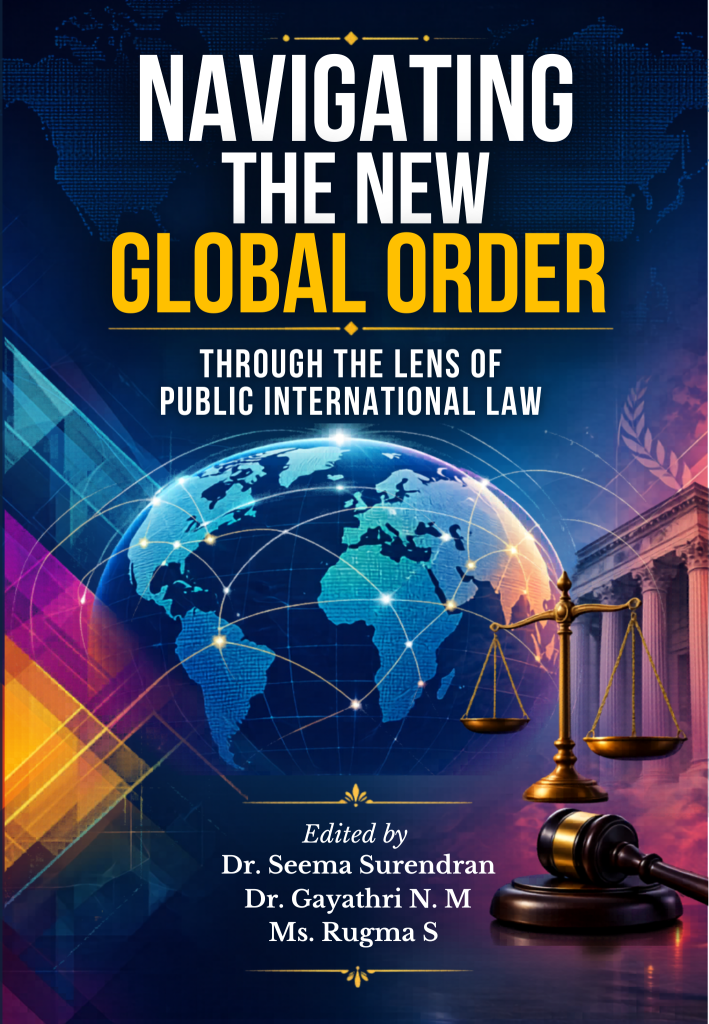
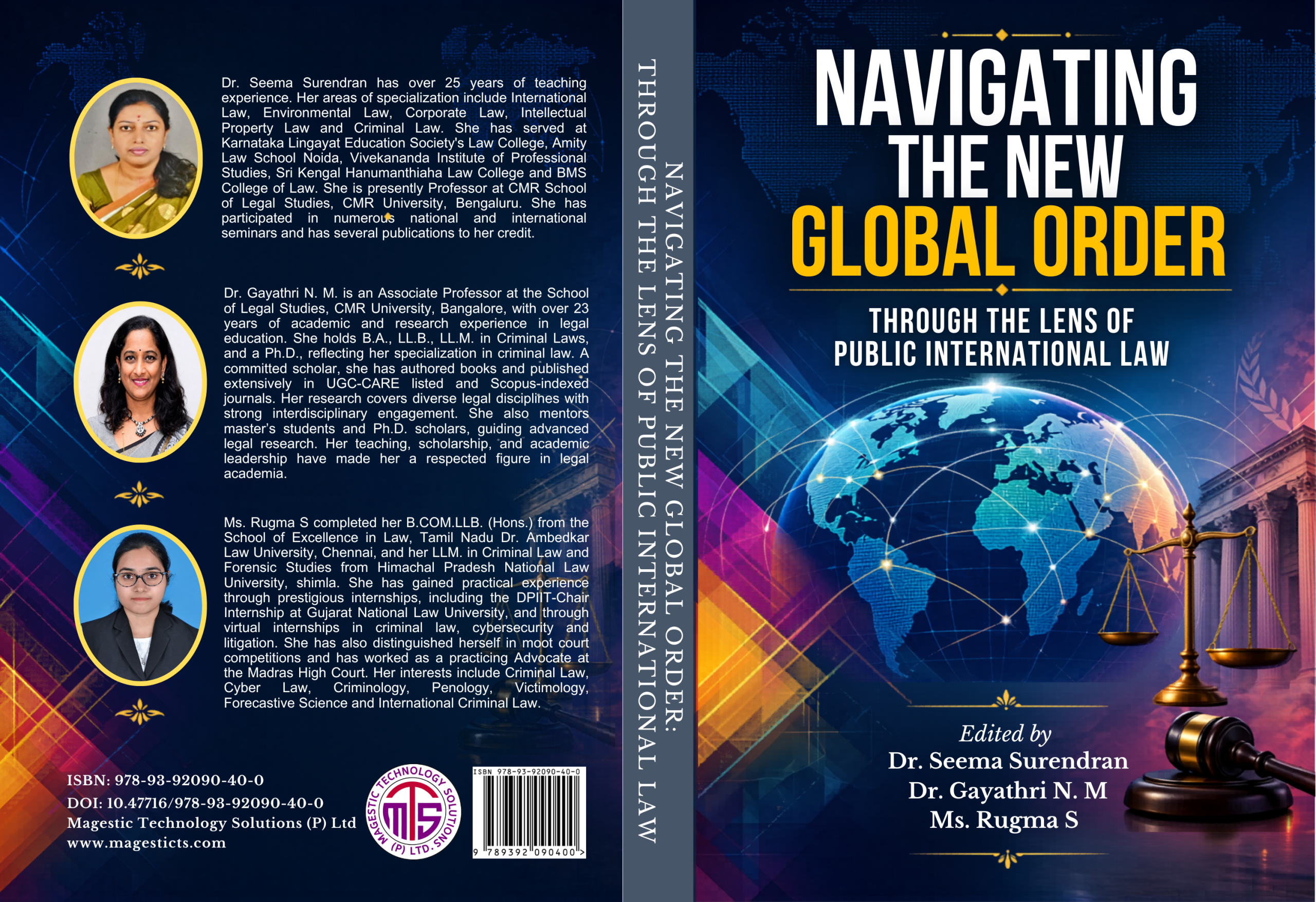
NAVIGATING THE NEW GLOBAL ORDER: THROUGH THE LENS OF PUBLIC INTERNATIONAL LAW
Editors:
Dr. Seema Surendran
Dr. Gayathri N. M
Ms. Rugma S
Publication Date:
4th May, 2026
No.of Pages: 298
Price: ₹ 450/-
ISBN:
978-93-92090-40-0
DOI:
Publisher:
Magestic Technology Solutions (P) Ltd.
Place of Publication:
Navigating the New Global Order
Through the Lens of Public International Law presents scholarly perspectives on law, institutions, sovereignty, accountability, human rights, maritime governance, treaty obligations, diplomacy, and emerging geopolitics.
Through the Lens of Public International Law
Edited by
Dr. Seema Surendran
Dr. Gayathri N. M
Ms. Rugma S
Magestic Technology Solutions (P) Ltd
Chennai · Tamil Nadu · India
Public international law remains indispensable, but it must be critically examined for the new global order.— Navigating the New Global Order
A scholarly legal map of sovereignty, institutions, responsibility, and global justice.
This edited volume examines contemporary public international law as a living framework for ordering relations among States, institutions, and individuals in a world shaped by conflict, displacement, technological change, maritime disputes, and institutional reform.
Core Legal Architecture
The book addresses the ICJ, United Nations organs, Security Council powers, veto concerns, State responsibility, treaty law, jurisdiction, diplomacy, and extradition.
Human and Global Dimensions
Chapters examine asylum, refugee protection, non-refoulement, statelessness, nationality, human rights, and the individual’s place within international legal systems.
Maritime and Territorial Order
The volume includes focused analysis of the EEZ, continental shelf, territorial waters, maritime boundaries, high seas, deep seabed mining, and ocean governance.
Emerging Geopolitics
It connects classical public international law with contemporary concerns including AI, pre-emptive self-defence, treaty obligations in crisis, and institutional democratic deficit.
Complete bibliographic and publishing information.
Use these details for academic catalogues, library records, publisher listings, citations, institutional pages, and promotional materials.
Designed for contemporary legal scholarship and institutional debate.
Institutions
ICJ, United Nations organs, Security Council, institutional legitimacy, veto power, collective security, and reform.
Treaties
Pacta sunt servanda, treaty interpretation, negotiation, ratification, crisis obligations, and legal stability.
Sovereignty
State identity, State succession, jurisdiction, rights and duties of States, self-defence, and use of force.
Human Protection
Asylum, refugee protection, non-refoulement, statelessness, nationality, human dignity, and human rights.
Law of the Sea
EEZ, continental shelf, territorial waters, maritime boundaries, high seas, deep seabed mining, and UNCLOS.
Diplomacy
Diplomatic envoys, privileges, immunities, accountability, treaty roles, and the Vienna Convention framework.
Security
Collective security, armed conflict, Article 51 self-defence, pre-emptive action, and international peace.
Future Law
Artificial intelligence, legal uncertainty, emerging technology, governance gaps, and future international regulation.
Forty chapters across public international law, institutions, and emerging geopolitics.
The book can be read sequentially for a connected understanding of the international legal order, or chapter-by-chapter as an independent scholarly reference.
The Role of the International Court of Justice in the Settlement of International Disputes
ICJ jurisdiction, consent, contentious cases, and dispute settlement.
Use of Force as Defense Under International Law
UN Charter framework and contemporary armed-conflict justifications.
Asylum as a General Principle of International Law
From sovereign tradition to constitutional and human-rights protection.
Modes of State Consent to ICJ Jurisdiction through Special Agreement
Special agreements as consent-based access to ICJ authority.
Citizenship Duality
Implications of dual nationality in India and international law.
Collective Security under the United Nations
Principal UN organs, peacekeeping, sanctions, and reform needs.
The Concept of Exclusive Economic Zone and Coastal State Rights
EEZ legal nature, rights, jurisdiction, and UNCLOS foundations.
Selective Justice in Public International Law
Why powerful actors rarely stand trial and how legal systems respond.
Conflicts, Recognition, and State Practice of Double Nationality
Dual nationality, diplomatic protection, and State practice.
State Responsibility for International Wrongful Acts
Attribution, breach, consequences, reparation, and enforcement limits.
India’s Maritime Rights and Obligations under UNCLOS
India’s law-of-the-sea framework, maritime zones, and disputes.
The Common Heritage of Mankind and Deep Seabed Mining
Legal and ethical challenges under UNCLOS.
Role of the International Seabed Authority
Deep-sea mining governance, environmental protection, and benefit sharing.
Asylum and Extradition in International Law
Protection, surrender, non-refoulement, and human-rights safeguards.
Territorial Waters and Maritime Boundaries
Legal challenges in Asia and regional maritime governance.
A Study of Continental Shelf under UNCLOS
Article 76, extended claims, CLCS, and State practice.
Right to Asylum as a Human Rights Protection Mechanism
Asylum as municipal, constitutional, and international protection.
Jurisdiction Beyond Territory
Limits, conflicts, cooperation, and legal uncertainty.
Diplomatic Immunity and Accountability
Immunity, abuse, waiver, persona non grata, and accountability gaps.
Understanding State Succession and State Identity
Continuity, succession, treaty stability, and responsibility.
An Analysis of the Rights, Duties, and Functions of the State
State authority, social responsibility, governance, and public functions.
Impact of Artificial Intelligence on International Law
AI, regulation, security, trade, human rights, and humanitarian law.
An Analysis of the Pacta Sunt Servanda Doctrine
The backbone of international treaty law.
Freedom of the High Seas Under International Law
Scope, limitations, and contemporary challenges.
Role of the United Nations in International Peace and Security
UN responsibility for collective security and institutional response.
Role of the UN Security Council in Maintaining International Peace
UNSC authority, practice, and peace-maintenance function.
Asylum in International Law
Between protection and politics.
Balancing Sovereignty and Justice
Principles and prerequisites of extradition in international law.
Diplomatic Envoys in Public International Law
Privileges, immunities, and contemporary challenges.
Right to Self-Defence under Article 51 of the UN Charter
Legality of pre-emptive action and security claims.
Treaty Obligations in Times of Crisis
Reassessing pacta sunt servanda in contemporary international law.
Human Rights of Stateless Persons under International Law
Protection of stateless persons and international obligations.
Statelessness as a Legal Issue in International Law
Nationality, exclusion, and rights implications.
Loss of Nationality and the Risk of Statelessness
An international legal perspective.
Right to Asylum
Humanitarian promise or political tool.
From Negotiation to Ratification
Role of diplomatic agents in international treaties.
Principles of Extradition
Critical analysis of international and domestic legal frameworks.
Privileges and Immunities of Diplomatic Agents under VCDR
Vienna Convention protections and limits.
The Legal Status of Diplomatic Envoys
Privileges, immunities, and obligations.
Veto Power and Democratic Deficit
Critical legal analysis of UN Security Council reform.
Edited by three legal scholars from CMR University’s School of Legal Studies.
Dr. Seema Surendran
Professor, School of Legal Studies, CMR University, Bengaluru
- Over 25 years of teaching experience.
- Specializes in International Law, Environmental Law, Corporate Law, Intellectual Property Law, and Criminal Law.
- Experienced in academic leadership, institutional administration, seminars, and publications.
Dr. Gayathri N. M
Assistant Professor, CMR University, School of Legal Studies, Bengaluru
- Over 23 years of academic and research experience in legal education.
- Holds B.A., LL.B., LL.M. in Criminal Laws, and Ph.D.
- Author, researcher, mentor, and supervisor for master’s and Ph.D. scholars.
Ms. Rugma S
Assistant Professor, School of Legal Studies, Bengaluru
- B.Com. LL.B. (Hons.) and LL.M. in Criminal Law and Forensic Studies.
- Practical experience through internships, moot courts, litigation, drafting, and legal research.
- Areas include Criminal Law, Cyber Law, Criminology, Penology, Victimology, Forensic Science, and International Criminal Law.
Magestic Technology Solutions (P) Ltd
Publisher and editorial contact details for catalogues, institutions, contributors, readers, and academic communication.
Publishing House
Editorial Contacts
Download or link the published book PDF.
The button below uses the suggested website path. If your uploaded PDF is stored under a different filename or folder, replace the href value with the final file URL.
This edited volume supports critical engagement with international law, legal responsibility, institutions, and global justice.— Navigating the New Global Order: Through the Lens of Public International Law