
Contemporary Issues in Securities, Investment and Insolvency Law
Home » Contemporary Issues in Securities, Investment and Insolvency Law
MTSPL
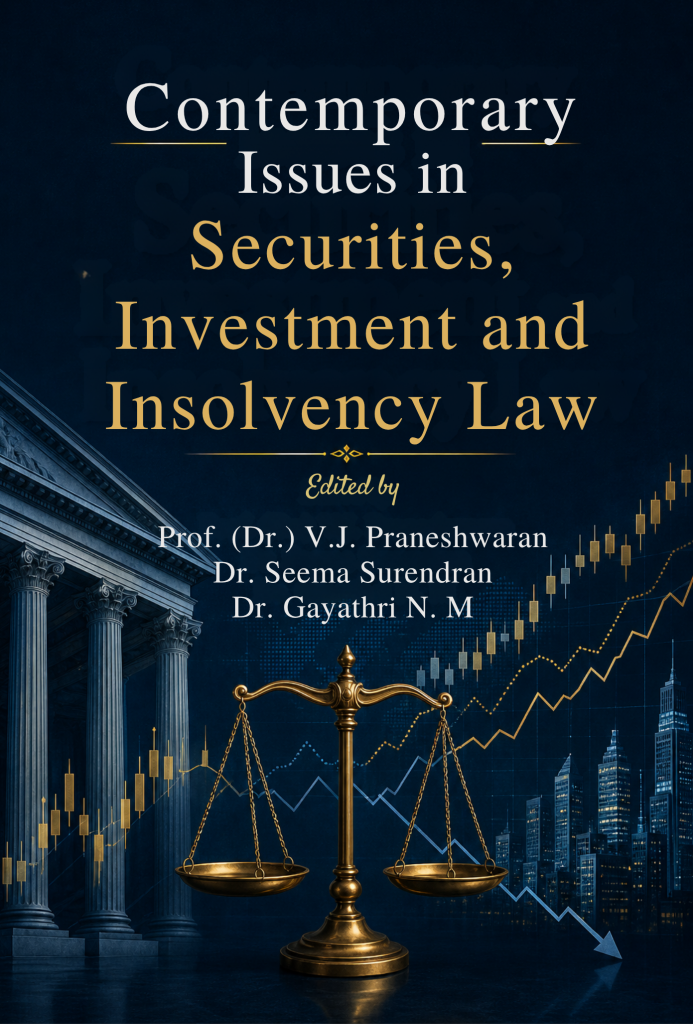
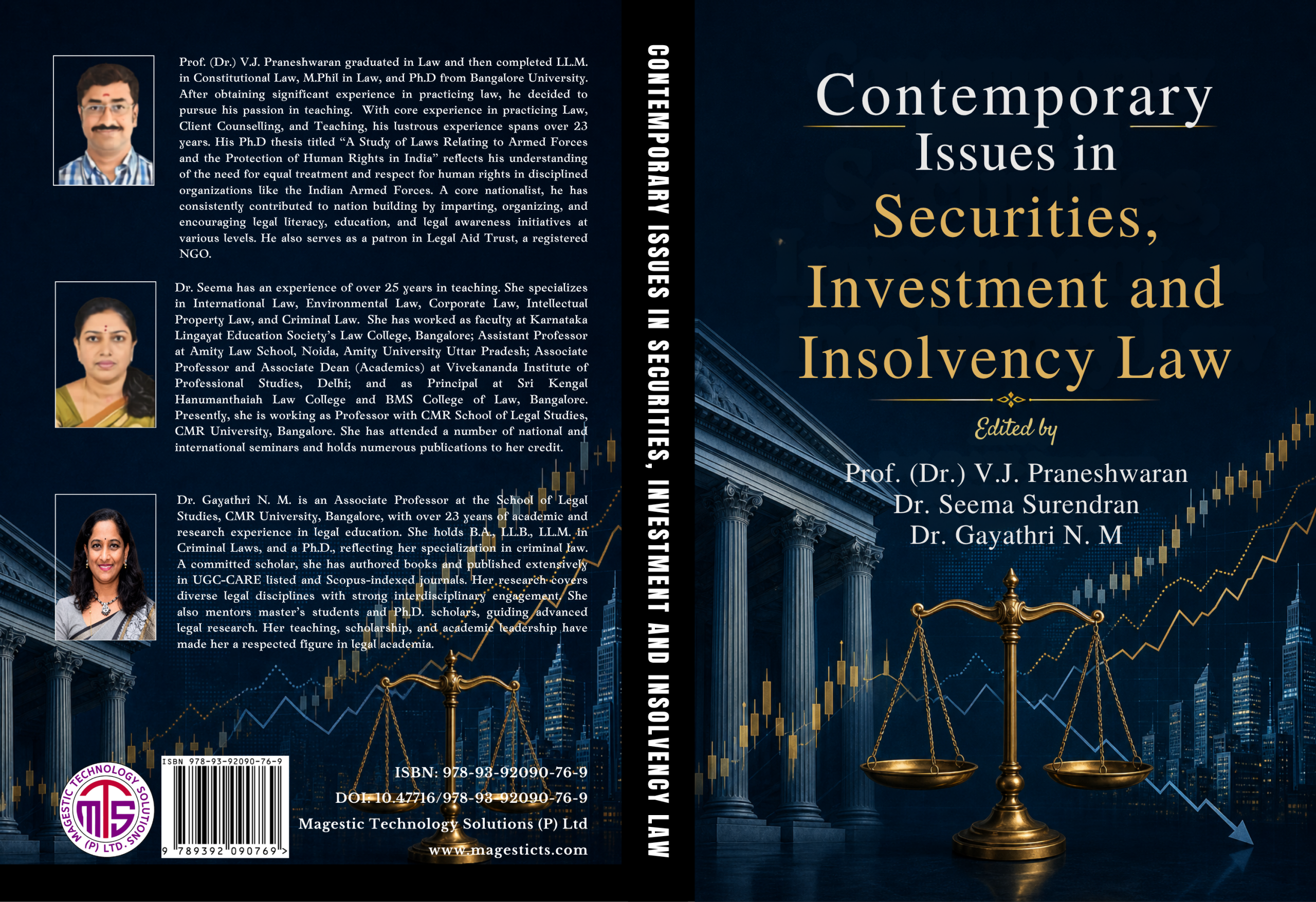
Contemporary Issues in Securities, Investment and Insolvency Law
Editors:
Prof. (Dr.) V.J. Praneshwaran
Dr. Seema Surendran
Dr. Gayathri N. M
Publication Date:
7th May, 2026
No.of Pages: 276
Price: ₹ 400/-
ISBN:
978-93-92090-76-9
DOI:
Publisher:
Magestic Technology Solutions (P) Ltd.
Place of Publication:
Edited Collection · Commercial Law · Securities Regulation · Insolvency Studies
Contemporary Issues in Securities, Investment and Insolvency Law
A scholarly edited volume examining the legal, regulatory, institutional, and market-facing issues that connect securities law, investment regulation, corporate finance, and insolvency jurisprudence in India.
About the Volume
Integrated Study of Securities, Investment and Insolvency Law
Contemporary Issues in Securities, Investment and Insolvency Law examines major contemporary questions in securities regulation, investment law, corporate finance, corporate governance, and insolvency jurisprudence. The book brings together doctrinal, regulatory, and analytical studies on the Indian securities market, investor protection, financial-market integrity, startup financing, venture capital, liquidation, corporate insolvency resolution, promoter liability, public shareholder rights, and the role of key regulatory institutions.
The volume is designed for scholars, researchers, practitioners, teachers, law students, and advanced readers interested in commercial law, securities law, corporate finance, market regulation, and insolvency studies. It may be read as a complete academic collection or consulted chapter by chapter as a focused reference work.
Core Academic Focus
- Securities market regulation and SEBI enforcement
- Investor protection, insider trading, fraud, and market manipulation
- Startup finance, venture capital, angel investment, and public financing
- Corporate insolvency, liquidation, promoter liability, and shareholder interests
- Commercial-law governance and financial-market accountability
Publication, Publisher and Contact Information
Complete Bibliographic Details
Copyright © 2026 Magestic Technology Solutions (P) Ltd. All rights reserved. The views expressed in individual chapters remain those of the respective authors.
Themes and Coverage
Subject Areas Covered in the Book
Editorial Board
About the Editors
Prof. (Dr.) V.J. Praneshwaran
Director, School of Legal Studies, CMR University
Prof. (Dr.) V.J. Praneshwaran graduated in Law and completed LL.M. in Constitutional Law, M.Phil in Law, and Ph.D. from Bangalore University. After gaining significant experience in legal practice, he pursued his passion for teaching. His academic and professional experience spans more than 23 years across law, client counselling, teaching, legal literacy, and legal awareness initiatives. His doctoral research, titled “A Study of Laws Relating to Armed Forces and the Protection of Human Rights in India,” reflects his commitment to equal treatment and respect for human rights in disciplined organisations such as the Indian Armed Forces. He also serves as a patron in Legal Aid Trust, a registered NGO.
Dr. Seema Surendran
Professor, School of Legal Studies, CMR University
Dr. Seema Surendran has over 25 years of teaching experience and specialises in International Law, Environmental Law, Corporate Law, Intellectual Property Law, and Criminal Law. She has served in several academic positions, including faculty at Karnataka Lingayat Education Society’s Law College, Bangalore; Assistant Professor at Amity Law School, Noida; Associate Professor and Associate Dean (Academics) at Vivekananda Institute of Professional Studies, Delhi; and Principal at Sri Kengal Hanumanthaiah Law College and BMS College of Law, Bangalore. She is presently Professor at CMR School of Legal Studies, CMR University, Bangalore, and has participated in national and international seminars with numerous publications to her credit.
Dr. Gayathri N. M
Assistant Professor, CMR School of Legal Studies
Dr. Gayathri N. M. is an Associate Professor at the School of Legal Studies, CMR University, Bangalore, with more than 23 years of academic and research experience in legal education. She holds B.A., LL.B., LL.M. in Criminal Laws, and a Ph.D., reflecting strong grounding in criminal law. She has authored books and published in UGC-CARE listed and Scopus-indexed journals. She actively mentors master’s students and Ph.D. scholars and is recognised for her contribution to teaching, legal research, and academic leadership.
Chapter Catalogue
Authors, Abstracts and Keywords
Each chapter below includes the author name, affiliation, abstract, and keywords for citation, indexing, academic discovery, and search-engine visibility.
Corporate Bankruptcy on Securities Markets in India: A Critical Analysis
Author: Alia Farooq
Student, LL.M. (Commercial Law), School of Legal Studies, CMR University
Abstract
Corporate bankruptcy has an enormous effect on the securities market in India as it has direct impacts on investors, shareholders, and the stability of the market at large. When a company is in the process of bankruptcy or insolvency, the prices of the shares normally drop drastically, leading to losses for both retail and institutional investors. Such a situation creates uncertainty in the market and lowers investor confidence, especially in the case of large or publicly listed companies. With the establishment of the Insolvency and Bankruptcy Code, 2016 (IBC), the method of corporate failure management has changed in India. The IBC aims at enabling the timely resolution of insolvency, maximization of asset value, and fostering discipline in the financial system. However, when it comes to insolvency, shareholders are often left with little protection, since creditors are given priority. This creates concern regarding investor rights and the transparency of the securities market. The paper explores the relationship between corporate bankruptcy and the securities market in India, with specific focus on market reactions, investor protection, and regulatory obstacles. It highlights the significance of SEBI and the IBC in balancing corporate recovery and market stability. The paper supports the idea of closer cooperation between securities regulation and insolvency law to protect investors and increase confidence in India’s capital markets.
Role of SEBI in the Regulation of Indian Securities Market: A Study
Author: Ameena
LL.M. (Commercial Law), SOLS, CMR University, Bengaluru
Abstract
The Securities and Exchange Board of India plays a central role in ensuring fairness, transparency, and stability in the Indian securities market. As the primary regulatory authority, SEBI oversees stock exchanges, market intermediaries, and listed companies while also working to protect investors and prevent unfair trade practices. This paper critically examines the regulatory role of SEBI by analysing its historical evolution, statutory powers, institutional functions, and enforcement mechanisms. It further evaluates SEBI’s contribution to investor protection, market integrity, and the regulation of insider trading and market manipulation. The study concludes that while SEBI has significantly strengthened India’s capital market framework, continuous regulatory adaptation, technological upgrading, and inter-agency coordination remain essential in addressing emerging market risks and sustaining investor confidence.
Protection of Public and Minority Shareholders under the Insolvency and Bankruptcy Code and SEBI Regulatory Framework: An Analysis
Author: Arjun S
LLM (Commercial Law), CMRU School of Legal Studies
Abstract
The protection of public and minority shareholders during corporate insolvency has emerged as a critical concern within India’s evolving corporate regulatory framework. The Corporate Insolvency Resolution Process administered under the Insolvency and Bankruptcy Code, 2016 primarily emphasizes creditor recovery and maximization of asset value, often relegating equity shareholders to the lowest priority in the statutory waterfall mechanism. As a consequence, minority and public investors frequently suffer dilution or extinguishment of their shareholding with limited participation in the resolution process. By contrast, the investor-protection mandate of the Securities and Exchange Board of India seeks to ensure transparency, fairness, and equitable treatment through disclosure obligations, delisting regula- tions, and market safeguards. This divergence creates regulatory tension between insolvency efficiency and shareholder protection. This paper analyses the extent to which the IBC and the SEBI regulatory framework collectively safeguard minority shareholders during insolvency proceedings. Through analysis of statutory provisions and academic commentary, the study identifies gaps in participatory rights, exit opportunities, and investor-focused protections, and suggests reforms to balance creditor interests with market confidence.
Trading Window Restrictions and Disclosure Obligations under the SEBI (PIT) Regulations, 1992: An Analysis
Author: Bharath D
LL.M. (Commercial Law), SOLS, CMR University, Bengaluru
Abstract
Securities and Exchange Board of India (Prohibition of Insider Trading) Regulations, 1992 was created so that unpublished price-sensitive information (UPSI) cannot be abused by insiders and to ensure fair and transparent trade in the securities markets. The key elements of this regulatory structure include trading window provisions, under which listed entities must close the trading window during sensitive corporate events, and prevent insiders and certain identified persons from trading in securities when material non-public information exists but has not yet reached the market. Alongside these limitations are elaborate disclosure requirements requiring promoters, directors, key managerial personnel, and other identified individuals to disclose their holdings and any alterations in those holdings within prescribed timelines to the company and to the stock exchanges, thereby increasing transparency and strengthening regulatory control. The paper provides a critical review of the design and functioning of trading window norms and the disclosure regime. It reviews the conceptual underpinnings of trading window norms and disclosure obligations as anchored in the 1992 Regulations, implementation problems, post-implementation amendments, and judicial and regulatory interpretations. The paper assesses how far these mechanisms are effective in preventing insider trading, minimizing information asymmetry, and enhancing market integrity, while also identifying gaps and new areas of reform in light of emerging market practices and comparative global standards informed by the United States, the United Kingdom, and the European Union.
A Critical Analysis of Liquidation Preference Rights under the Indian Insolvency and Bankruptcy Code
Author: Kaushal Kamath
Student, LL.M. (Commercial Law), CMR University, School of Legal Studies
Abstract
Private Equity and Venture Capital investors typically fund Indian startups using hybrid instruments, such as Compulsorily Convertible Debentures (CCDs) or Preference Shares, backed by a contractual promise known as a liquidation preference. This promise ensures that if the company fails, these investors are repaid before other shareholders. However, this private contractual arrangement often collides with the rigid mandates of the Insolvency and Bankruptcy Code, 2016. Under the IBC’s waterfall mechanism under section 53, the law mandates a strict hierarchy of payment where secured creditors, such as banks, must be paid in full before any capital is returned to shareholders. This paper argues that Indian courts have effectively nullified the value of liquidation preference rights in insolvency scenarios. By classifying hybrid instruments as equity rather than financial debt in landmark judgments such as IFCI Ltd v Sutanu Sinha and EPC Constructions v Matix Fertilizers, the judiciary has prioritized the statutory rescue of the company over the enforcement of private investor contracts. Consequently, investors holding these instruments are often relegated to the bottom of the payment queue, rendering their priority rights largely meaningless when they are needed most. The study concludes that the current legal framework creates a protection gap for both foreign and domestic risk capital in India.
Dematerialization of Securities under the Depositories Act, 1996: A Legal Analysis
Author: Bindu. V
LL.M. (Commercial Law), SOLS, CMR University, Bengaluru
Abstract
The securities market in India has been transformed by the adoption of the Depositories Act, 1996, marking a crucial transition from a paper-based trading system to an electronic one. Dematerialisation of securities removed many of the risks and inefficiencies associated with physical certificates, such as forgery, loss, and delays in transfer. This paper examines the law relating to depositories, the rights and liabilities of depository participants, and the settlement framework under the Act. It highlights the manner in which dematerialization has increased transparency, minimized transaction costs, and enhanced investor confidence. At the same time, issues such as cyber-security risk, technical failures, and regulatory compliance remain significant concerns. The study also explores rematerialization provisions, which provide flexibility to investors, and evaluates the role of SEBI in supervising depositories and protecting investor interests. Comparative understanding drawn from global practices is used to contextualize the advancement of the securities market in India. Through analysis of statutory provisions, case law, and regulatory guidelines, the paper underlines the practical consequences of dematerialization for corporate governance and investor protection. It concludes that the Depositories Act is a landmark in India’s effort to build a strong, technologically focused capital market through a balance of innovation and law.
Framework Governing Venture Capital and Startup Financing in India – A Legal Analysis
Author: Thelma Letitia Dcunha
Student, LL.M. (Commercial Law), School of Legal Studies, CMR University
Abstract
This paper provides a comprehensive discussion of the legal and regulatory framework that would determine venture capital investments and startup financing in India. It discusses how the legal system of India has been moulded to suit the special requirements of risk capital investment and at the same time safeguard the investors, regulation and flexibility of the entrepreneur. The paper begins with the historical development of regulation of venture capital in India since the monopolistic system in Indian ICICI up to the liberalization reforms that led to the liberalization of the Indian market to foreign and personal investment. It examines the laws established by the SEBI related to the venture capital funds, alternative investment funds and registration, operation and investment restrictions. The study explores FDI policies as well as the provisions of the FEMA, which affects the cross-border venture investments such as automatic and approval route, sectoral limit, and downstream investment provisions. Corporate law frameworks as stipulated in the Companies Act in areas of share classes, shareholder agreement, employee stock option plans and minority shareholder protections are also examined and their effect on venture capital transactions. The paper reviews the tax consequences of venture capital investments including capital gains tax, angel tax problems and tax benefits on startup investments. It also examines the regulatory frameworks of other financing initiatives such as crowdfunding platforms, peer-to-peer lending and invoice discounting and whether they are limited or not and whether they have to comply with legal mandates. It concludes with legal Framework Governing Venture Capital and Startup Financing in India – A Legal Analysis proposals to streamline compliance with rules and make them more uniform, as well as explain taxes and establish special dispute resolution methods. Such amendments are meant to facilitate venture capital and startup development in India.
Insider Trading as a Corporate Crime in India: Critical Analysis of SEBI’s Reforming Enforcement
Author: Charitha R Reddy
LL.M. (Commercial Law), CMR University School of Legal Studies, Bengaluru
Abstract
Insider trading represents one of the most pernicious forms of corporate misconduct, undermining investor confidence and compromising the integrity of capital markets. In India, the regulatory framework governing insider trading has undergone a marked transformation from the SEBI (Prohibition of Insider Trading) Regulations, 1992 to the more structured 2015 Regulations and subsequent amendments. Complementing this, the Companies Act, 2013, through provisions on directors’ duties, key managerial personnel responsibilities, and corporate disclosures, reinforces the obligation of fair dealing and transparency within companies. Despite these progressive legal developments, enforcement continues to pose significant challenges. SEBI, as the principal enforcement authority, faces obstacles such as evidentiary limitations, complex corporate shareholding patterns, and difficulties in establishing intent and communication of Unpublished Price Sensitive Information (UPSI). This paper critically examines insider trading as a corporate crime within the Indian securities-law framework, focusing on SEBI’s investigative and adjudicatory mechanisms. It analyses landmark cases and evaluates their implications for regulatory consistency and deterrence. Further, the paper explores how weak corporate-governance structures, inadequate compliance systems, and insufficient whistleblower protection dilute the preventive mechanisms envisaged under both SEBI regulations and the Companies Act, 2013. It concludes with reform-oriented suggestions for strengthening SEBI’s surveillance through technology integration, clarifying evidentiary standards, enhancing board-level accountability, and aligning India’s insider-trading framework.
The Gatekeeping Role of Investment Banks in Corporate Governance: An Indian Securities Law Perspective
Author: Sreetesha Roy Chowdhury
Student, LL.M. (Commercial), School of Legal Studies, CMR University, Bengaluru
Abstract
Investment banks occupy a pivotal position in modern securities markets, functioning as critical gatekeepers of corporate governance. In India’s disclosure-based regulatory framework, significant reliance is placed on investment banks, specifically lead managers and merchant bankers, to verify the accuracy of disclosures, perform rigorous due diligence, and certify regulatory compliance during capital-raising transactions. This article examines the evolving gatekeeping role of investment banks within the Indian securities regime, with specific reference to the Securities and Exchange Board of India framework. The article analyzes how investment banks influence corporate governance through issuer vetting and pricing mechanisms under the SEBI (ICDR) Regulations, 2018 and ongoing disclosure obligations under the SEBI (LODR) Regulations, 2015. Utilizing Gatekeeper Theory, the study evaluates whether the existing legal framework imposes sufficient accountability to justify the regulatory trust placed in these intermediaries. It argues that while Indian law increasingly treats investment banks as private monitors, enforcement mechanisms remain fragmented. Through a doctrinal analysis of recent SEBI enforcement actions and comparative insights from the United States, the article identifies structural challenges, including fee-based incentives and limited deterrence. The article concludes by recommending a more coherent, strictly defined liability framework to enhance the efficacy of investment banks as guardians of market integrity in Indian capital markets.
Challenges Faced by Startups in Raising Finance in India: An Analysis
Author: Chaithra A. Salian
LL.M. (Commercial Law), School of Legal Studies, CMR University
Abstract
The startup ecosystem in India is currently one of the most vibrant entrepreneurial environments in the world, although availability of sufficient finance remains the most significant obstacle to the existence, development, and expansion of startups. This paper explores the multidimensional financial issues facing startups in India, and the structural, institutional, and socio-economic aspects that hinder access to capital at diverse points in the lifecycle of a startup. The research adopts a doctrinal and analytical methodology, utilizing both primary and secondary legislative frameworks, regulations, and secondary data sources such as industry reports and government publications. The study establishes that traditional banking institutions remain largely closed to startups because of inflexible collateral policies, a risk- averse lending culture, and institutional inability to assess innovation-driven business models. Within the formal risk-capital ecosystem, venture-capital and private-equity investment remains highly concentrated in metropolitan centres and biased towards technology sectors, thereby marginalising manufacturing, agricultural, and social enterprises. Government interventions such as Startup India, the SIDBI Fund of Funds, and tax incentive programmes are assessed in terms of their actual implementation and their effectiveness in filling financing gaps. The paper also evaluates emerging alternative financing systems such as crowdfunding, peer-to-peer lending, and revenue-based financing, together with their present limitations in the Indian regulatory environment. It further examines the unequal access to finance experienced by women entrepreneurs and founders from marginalised backgrounds, placing access to finance within larger questions of equity and inclusion. The paper concludes with specific policy suggestions and ecosystem-level approaches to make the financial environment more inclusive and efficient for Indian startups.
Insider Trading and Investor Protection in India: Role of the Securities and Exchange Board of India (SEBI)
Author: Chinmayi A. Shet
Student, LL.M. (Commercial Law), School of Legal Studies, CMR University
Abstract
Insider trading is trading based on unpublished price-sensitive information used to buy or sell securities by persons enjoying an unfair informational advantage, and it reduces trust in the securities market. Securities regulation in India therefore places major emphasis on investor protection. This paper discusses insider trading and the role of the Securities and Exchange Board of India in preventing such activities and safeguarding investors. The article describes the legal framework regulating insider trading, particularly the SEBI (Prohibition of Insider Trading) Regulations. It examines the powers of SEBI, including investigation, enforcement, and penalties. It also discusses preventive mechanisms such as disclosure requirements, trading restrictions, and codes of conduct that promote transparency and fairness. Further, SEBI plays an important role in investor protection through grievance-redressal mechanisms, regulation of intermediaries, and investor education. These measures aim to prevent fraud and enable informed investment decisions, while also emphasizing timely and truthful corporate disclosures. Despite the reforms introduced by SEBI, significant challenges remain, including the difficulty of detecting insider trading and preventing misuse of confidential information. Nevertheless, SEBI has strengthened market discipline and investor confidence. The paper concludes that SEBI remains an indispensable institution in deterring insider trading and safeguarding investors, and that a fair and transparent securities market requires continuous regulatory improvement, stronger enforcement, and greater investor awareness.
An Analysis of Delisting of Securities and its Procedure
Author: Ravitheja V K
Student, LL.M. (Commercial Law), School of Legal Studies, CMR University, Bengaluru
Abstract
Delisting refers to the permanent removal of a company’s securities from a stock exchange, thereby ending its status as a publicly traded entity. This process is fundamentally categorized into two types: voluntary and compulsory delisting. Voluntary delisting occurs when a company chooses to exit the exchange of its own accord, often driven by strategic reasons such as mergers, acquisitions, a desire for greater operational privacy, or the need to eliminate the high costs and regulatory burdens associated with public compliance. By contrast, compulsory delisting is a formal penalty imposed by the stock exchange or regulatory authorities, usually where a company violates listing agreements, fails to meet minimum financial requirements, or neglects timely disclosure obligations. The procedure for delisting is strictly governed in order to safeguard minority shareholders. In the case of voluntary delisting, the process begins with board approval followed by a special resolution of shareholders. A central step is the provision of an exit opportunity, where promoters must offer to buy back shares from public shareholders. For investors, understanding these procedures is vital, because delisting directly affects liquidity and the valuation and tradability of their holdings. This paper analyses the process of delisting of securities and examines its implications for shareholder value and market efficiency. It argues that the regulatory environment must remain sufficiently flexible to manage delistings without compromising minority-shareholder rights. By balancing stringent oversight with market accessibility, regulators can ensure that the listing-delisting cycle promotes a healthy and dynamic financial ecosystem.
Securities Regulation in India in Preventing Financial Fraud: A Legal Study
Author: Dhanush J
Student, LL.M. (Commercial Law), School of Legal Studies, CMR University
Abstract
India’s securities market has grown rapidly over the past three decades, but that growth has also been accompanied by financial scandals, market fraud, and investor losses. The two laws that form the backbone of market regulation in India, namely the Securities Contracts (Regulation) Act, 1956 (SCRA) and the Securities and Exchange Board of India Act, 1992 (SEBI Act), have played a central role in combating financial fraud and protecting investors. This article examines how these two laws operate together to prevent fraud in India’s capital markets. It analyzes key provisions of both statutes, discusses important court decisions, and identifies areas where the law continues to fall short. The article concludes by suggesting practical reforms that can strengthen the existing framework without requiring a complete overhaul.
A Critical Analysis of the Insolvency and Bankruptcy Code, 2016
Author: Sherlin Jacob
Student, LL.M. (Commercial Law), School of Legal Studies, CMR University, Bengaluru
Abstract
One of the largest reforms towards a single, time-limited, and creditor-oriented insolvency system in India is the Insolvency and Bankruptcy Code, 2016. This paper discusses how the Code has helped in enhancing credit discipline, recovery rates, and financial stability, while also examining its institutional structure and functioning. Although the IBC has several benefits, it continues to face problems relating to delays, institutional inefficiencies, stakeholder imbalance, and judicial intervention. The paper also assesses the effects of the COVID-19 pandemic and the Insolvency and Bankruptcy Code (Amendment) Ordinance, 2020, which temporarily stayed insolvency proceedings and raised concerns regarding the weakening of creditor rights. Overall, the study highlights the trade-off between economic stability and effective insolvency-regime enforcement. It critically evaluates the existing framework to determine whether it is sufficient to address emerging practical issues in implementation and argues that further reforms are necessary to enhance institutional capacity and make the insolvency process more consistent and efficient.
Insider Trading in India: A Critical Study of the SEBI (Prohibition of Insider Trading) Regulations
Author: Gayathri Kurup
Student, LL.M. (Commercial Law), School of Legal Studies, CMR University
Abstract
The securities market plays a vital role in the economic development of a country by facilitating capital formation and protecting investor interests. One of the major threats to the fairness and transparency of the securities market is insider trading. Insider trading undermines investor confidence and distorts the principle of equal access to information. In India, insider trading was regulated under the SEBI Regulations, 1992, which were later strengthened through amendments and replaced by the SEBI (Prohibition of Insider Trading) Regulations, 2015. This paper examines the concept of insider trading, its impact on the securities market, and the regulatory framework established by SEBI to curb such practices. It analyses the powers and functions of SEBI in preventing insider trading and evaluates the effectiveness of the existing legal framework. The study also highlights key challenges in enforcement and suggests measures for strengthening regulatory mechanisms to ensure market integrity and investor protection.
The Role of Venture Capital in Startup Growth and Innovation: An Analysis
Author: Varsha Kiran Prabhu
Student, LL.M. (Commercial Law), School of Legal Studies, CMR University
Abstract
Venture capital has become an important element in determining the development and innovative potential of startups within modern economies. In comparison with traditional sources of finance, venture capital extends beyond merely providing capital and often involves active engagement with entrepreneurs during the early and risky stages of business growth. This paper examines the contribution of venture capital to the development of startups and the creation of innovation, focusing on its effect on decision-making, risk-taking, and long-term value creation. Startups often operate under uncertain conditions, with limited resources and unexplored markets, and venture-capital funding fills these gaps by providing not only finance but also strategic advice, industry knowledge, and access to valuable networks. This kind of involvement enables startups to scale operations, invest in research and development, and bring new ideas into commercial viability through products and services. The paper also highlights the role of venture capital in promoting experimentation and technological development by accepting risks that are often avoided by traditional lending institutions. At the same time, the paper acknowledges the challenges associated with venture-capital financing, including pressure to grow rapidly, limitations on founder autonomy, and unequal funding across sectors and regions. Using a general and conceptual approach, the research aims to provide a balanced understanding of venture capital both as a facilitator of innovation and as a force shaping the entrepreneurial environment. The paper concludes that venture capital is a key factor in bringing startups to life and accelerating innovation and therefore remains a vital component of economic development and entrepreneurial success in the present day.
From Boardroom to Chatroom: Insider Trading Liability for Informal Disclosure of Unpublished Price Sensitive Information
Author: G Kusuma
Student, LL.M. (Commercial Law), CMR University, School of Legal Studies
Abstract
We are moving towards a faster communication environment in which information reaches others almost instantly. In order to ensure that these communications are not publicly shared or easily accessible, they are increasingly encrypted. While this may be beneficial in one context, it becomes a challenge in another, because insider trading is harder to trace when it occurs through closed digital platforms. Insider trading undermines investor trust and is harmful both to the economy and to the company concerned. Such forms of trading are usually regulated by the SEBI (Prohibition of Insider Trading) Regulations, 2015. This paper examines the regulation and seeks to understand insider trading and its core definitions. It also considers whether the existing framework can encompass informal digital dis- closures and analyses evidentiary issues relating to access, intent, and possession of Unpublished Price Sensitive Information (UPSI). It further explores the evolving concepts of communication and procurement of UPSI and the extent of liability when information flows through informal channels. Finally, it considers the balance that may be struck between market surveillance, privacy concerns, procedural fairness, and the rule of proportionality.
Angel Investment and Venture Capital as a Source of Startup Finance: A Legal Study
Author: Kshema K Poojary
Student, LL.M. (Commercial Law), School of Legal Studies, CMR University
Abstract
Startups drive innovation and create jobs. They can also strengthen the wider economy. Yet many startups struggle to obtain finance, particularly at the early stages. Banks are reluctant to lend because the risks are high and there is little collateral. Angel investors and venture-capital firms emerged as alternative sources of finance. They provide capital, mentorship, business advice, and network access. Such support can significantly improve the growth prospects and success of startups. This paper critically analyses angel investment and venture capital from a legal perspective, with particular focus on their role in the startup ecosystem. It examines their definitions, features, differences, and the legal framework governing them in India, especially under SEBI regulation. The paper also considers the contribution of tax policy, supportive government programmes, and investor-protection mechanisms. In addition, it identifies legal and operational barriers, such as regulatory compliance, valuation difficulties, and exit strategies. The paper concludes by recommending a balanced legal framework that encourages investment flows without jeopardising the interests of any party, thereby supporting startup growth and broader economic sustainability.
Lifting the Corporate Veil under the Insolvency and Bankruptcy Code: A Study of Promoter Liability
Author: Navyashree
Student, LL.M. (Commercial Law), School of Legal Studies, CMR University
Abstract
The separate corporate personality doctrine, established in Salomon v A Salomon & Co Ltd, has conventionally provided shareholders and promoters with a strong shield of limited liability, protecting personal assets from corporate liabilities. However, that protection has been significantly recalibrated within the insolvency framework of India, as the Insolvency and Bankruptcy Code, 2016 has shifted priorities in favour of creditors and increased the accountability of those controlling corporate entities. This paper discusses the changing dimensions of promoter liability under the IBC, with particular focus on section 29A, which renders defaulting promoters ineligible to re-enter the resolution process and thereby seeks to prevent misuse of the insolvency regime. Adopting a doctrinal and case-law-based approach, the paper examines judicial trends relating to personal guarantors, the limited nature of subrogation rights, and regulatory developments that increasingly erode the distinction between corporate and personal liability. Special attention is given to recent jurisprudence, especially the ruling of the Supreme Court in Dilip B. Jiwrajka, which strengthens creditor primacy and heightens promoter responsibility. The paper argues that the modern insolvency regime reflects a shift from strict corporate separateness towards a more purposeful and interventionist model. It concludes that commercial integrity is increasingly being given greater weight than traditional corporate-veil protection in India.
The Role of the Resolution Professional in the Corporate Insolvency Resolution Process
Author: Tejaswini D Naidu
LL.M. (Commercial Law), CMR School of Legal Studies
Abstract
The Corporate Insolvency Resolution Process (CIRP) under the Insolvency and Bankruptcy Code, 2016 (IBC) positions the Resolution Professional (RP) as the central actor responsible for managing the corporate debtor as a going concern while facilitating a time-bound resolution. Though the IBC envisions the RP as an independent and neutral intermediary, the practical functioning of the CIRP raises critical concerns regarding the extent of such independence and the effectiveness of accountability mechanisms. This paper examines the statutory framework governing the appointment, powers, and duties of the RP and analyses how these provisions operate in practice. Through a study of key judicial pronouncements of the Supreme Court and the National Company Law Appellate Tribunal (NCLAT), it evaluates evolving jurisprudence on the RP’s role, particularly in relation to the Committee of Creditors (CoC) and the Insolvency and Bankruptcy Board of India (IBBI). The paper argues that although the IBC incorporates safeguards to ensure professional independence, the RP’s functional dependence on the CoC and exposure to disciplinary action often undermine the intended neutrality of the role. It further assesses the accountability framework applicable to RPs and highlights structural challenges that impede decision-making autonomy. Finally, the paper proposes measures to strengthen the institutional position of RPs while maintaining effective oversight.
The Critical Analysis of Market Manipulation under the SEBI (Prohibition of Fraudulent and Unfair Trade Practices Relating to Securities Market) Regulations, 2003
Author: Neeksha K N
LL.M. (Commercial Law), School of Legal Studies, CMR University, Bengaluru
Abstract
The Securities and Exchange Board of India (Prohibition of Fraudulent and Unfair Trade Practices Relating to Securities Market) Regulations, 2003 (PFUTP Regulations) constitute the primary statutory framework for addressing market manipulation in India. This paper critically examines the evolution, scope, and enforcement of market manipulation under regulations 3 and 4, read with section 12A of the SEBI Act, 1992, with particular focus on how SEBI and Indian courts have interpreted concepts such as manipulative or deceptive device, fraud, and unfair trade practice in cases involving circular trading, pump-and-dump schemes, front-running, and algorithmic abuse. Drawing on contemporary scholarship that analyses the PFUTP regime and its amendments as a response to market abuse, the study interrogates whether the current mix of principles-based and rule-based prohibitions adequately captures complex strategies in digital and high-frequency trading environments and aligns with comparative standards for liability in modern securities markets. Using key decisions such as SEBI v Rakhi Trading Pvt Ltd and N Narayanan v SEBI as doctrinal anchors, the paper evaluates the emerging Indian standard for inferring manipulative intent from trading patterns, the treatment of mens rea, and the proportionality of sanctions, including in the context of front-running within asset-management structures where PFUTP has been held to prevail over sectoral norms. It argues that while the PFUTP Regulations have progressively expanded SEBI’s ability to address market abuse, persistent ambiguities in the definitional and evidentiary thresholds for market manipulation risk under-deterrence in technologically sophisticated cases, thereby necessitating clearer statutory guidance and more coherent judicially articulated standards. The Critical Analysis of Market Manipulation under the SEBI (Prohibition of Fraudulent and Unfair Trade Practices Relating to Securities Market) Regulations, 2003
Investor Protection Mechanisms Under SEBI: An Analysis
Author: Namrata Philip
Student, LL.M. (Commercial Law), School of Legal Studies, CMR University, Bengaluru
Abstract
Investor protection is essential to ensure confidence in the securities market. In India, the Securities and Exchange Board of India (SEBI), which is established under the SEBI Act, 1992, is considered to be the focal point in protecting the interests of investors. The paper evaluates the regulatory, supervisory and enforcement practices by the SEBI based on disclosure, insider trading and prevention of fraudulent and unfair trade practices. It also assesses enforcement tools like investigation, adjudication, and appeal. The paper analyses these mechanisms concerning the recent developments and judicial rulings and outlines the main difficulties and proposes the measures to improve investor protection and improve the market integrity in the Indian securities market.
Start Ups and Public Financing in India: Regulatory Framework under SEBI
Author: Preethi V
Student, LL.M. (Commercial Law), School of Legal Studies, CMR University, Bengaluru
Abstract
Start-ups in India have become vibrant sources of innovation, employment, and economic development. In response to the increasing need for capital, start-ups are increasingly opting for public financing as a viable option for scaling up their operations. Public financing refers to the practice of raising capital from the public through methods such as IPOs, crowdfunding platforms, and stock exchanges. SEBI plays a major regulatory role by designing rules that promote transparency and investor protection. The regulatory framework established by SEBI seeks to balance entrepreneurial freedom with market discipline by laying down eligibility criteria, disclosure standards, and compliance obligations. This study examines how SEBI’s regulations assist start-ups in raising public capital while ensuring governance, accountability, and investor protection. It also analyses initiatives such as the Innovators Growth Platform, streamlined listing norms, and the regulations for alternative investment funds. By examining these measures, the study identifies both the benefits and the challenges faced by start-ups as they enter the regulatory environment. The paper highlights the intersection of regulation and entrepreneurship and shows how SEBI regulations affect the ways in which start-ups receive capital, foster innovation, and protect investors in a high-risk environment.
SEBI Regulations Governing Venture Capital Funds in India: An Analytical Study
Author: Sakthi Eswar S
LL.M. (Commercial), CMR University
Abstract
Venture capital has emerged as a cornerstone of modern economic development, particularly in innovation-driven economies. In India, the growth of startups and entrepreneurial ventures has been closely linked with the availability of venture capital financing. Recognizing its importance, the Securities and Exchange Board of India (SEBI) has developed a regulatory framework to govern venture capital funds, ensuring both investor protection and market efficiency. Beginning with the SEBI (Venture Capital Funds) Regulations, 1996 and transitioning to the SEBI (Alternative Investment Funds) Regulations, 2012, the regulatory regime has evolved significantly. This paper provides a comprehensive and critical analysis of the SEBI framework governing venture capital funds in India, examining its legal structure, investment norms, governance mechanisms, taxation, foreign investment participation, and existing challenges. It also evaluates the effectiveness of the regulatory regime and suggests reforms to enhance its efficiency and global competitiveness.
Role of Angel Investors in Startup Growth and Early-Stage Funding in India – An Analysis
Author: Sithara
Student, LL.M. (Commercial Law), School of Legal Studies, CMR University
Abstract
This paper explores the critical role played by angel investors in bridging the gap between startups and other sources of funding by providing more than financial services such as mentorship, networking, and strategic guidance that are essential in entrepreneurial success. Angel investors who are usually rich individuals that put in their own funds in the emerging businesses, play an important role in the finance of the entrepreneurial world. The paper looks at the unique characteristics and criteria of the angel investment that distinguishes them in comparison with the venture capitalists, banks and family offices. It examines the evolution of angel investing in India, after the emergence of organized angel networks, with the scope of investment beyond individual networks. The study examines the standard steps involved in the investment process such as deal sourcing, due diligence, valuation, terms sheet negotiation and post investment participation that characterizes angel investment. The study also examines the other ways through which angel investors contribute to the startups other than through money. They provide consultation, networking and assistance in locating customers and raising additional funds. The paper discusses about obstacles that restrict angel investments such as ambiguous regulations, taxation, absence of exit means of investments, information scarcity, and poor early-stage equity markets. The paper will contain some examples of how angel investments have been used to launch startups to successful and cases where they have failed to do so. The study examines the government initiative to promote angel investments such as tax breaks, co-investing schemes, and waivers of the regulations. It concludes with recommendations on how to expand angel investment in India by articulating its rules, taxation, building the ecosystem, educating investors, and creating platforms that would render it more democratic and risk contained at the same time.
Role of Securities Regulation in Managing Investment Risk in Indian Financial Markets
Author: Surabhi S
LL.M. (Commercial Law) Student, School of Legal Studies, CMR University
Abstract
The Indian financial market plays a pivotal role in mobilizing savings and channeling investments, making effective securities regulation essential for managing investment risk. This paper examines the role of securities regulation in mitigating risks faced by investors in Indian financial markets, with particular reference to the regulatory framework established under the Securities and Exchange Board of India Act, 1992. It analyzes how regulatory mechanisms such as disclosure requirements, market surveillance, insider trading regulations, and investor protection measures contribute to transparency, fairness, and stability in the securities market. The study also evaluates the effectiveness of SEBI’s enforcement powers in addressing market manipulation, fraud, and information asymmetry, which are major sources of investment risk. Through doctrinal analysis and reference to relevant regulations, the paper highlights the strengths and limitations of the existing regulatory regime. It further discusses emerging challenges posed by technological advancements and complex financial instruments. The paper concludes by emphasizing the need for continuous regulatory reforms to strengthen investor confidence and ensure sustainable growth of the Indian financial markets.
Voluntary Liquidation Under the Insolvency and Bankruptcy Code, 2016 – A Legal Analysis
Author: Swathi
LL.M. (Commercial Law), School of Legal Studies, CMR University
Abstract
This paper examines voluntary liquidation as stipulated in the Insolvency and Bankruptcy Code, 2016, and the way in which it has altered the process through which businesses in India may cease operations while still remaining solvent. Voluntary liquidation allows firms to shut down without the elaborate court-driven procedures that characterized earlier law. Before the IBC, winding up was governed by multiple statutes and was often slow and cumbersome. The IBC consolidated the rules into a single framework and simplified the process. This study reviews the statutory basis of voluntary liquidation under the IBC, the distribution of assets by the liquidator, the protection afforded to creditors, the eligibility requirements for entering voluntary liquidation, the implications for members and creditors, and the duties of liquidators. It also discusses practical difficulties such as valuation, stakeholder disputes, and compliance burdens, and compares voluntary liquidation with compulsory liquidation and the corporate insolvency resolution process. The paper argues that voluntary liquidation under the IBC, 2016 provides a cleaner and more structured exit route for solvent corporate persons while strengthening the broader insolvency system in India.
Promoters Lock-in under SEBI ICDR Regulations: Balancing Market Integrity and Capital Mobilization in India
Author: Rajpoorani Bharat T
LL.M. (Commercial Law), School of Legal Studies, CMR University, Bengaluru
Abstract
Another important regulatory mechanism used to regulate the primary capital market of India is the promoters’ lock-in requirement under the Securities and Exchange Board of India (Issue of Capital and Disclosure Requirements) Regulations, 2018. These requirements stipulate that a prescribed shareholding of promoters must be retained for a specified period after an Initial Public Offering, with the object of ensuring promoter commitment, discouraging opportunistic exit, and strengthening investor trust. At the same time, lock-in norms directly affect the ability of companies to mobilise capital efficiently by influencing liquidity and pricing of securities. Recent regulatory changes introduced by the Securities and Exchange Board of India attempt to balance market integrity with capital formation and ease of doing business by reducing lock-in periods and relaxing certain requirements. However, these changes also raise questions regarding the sufficiency of existing safeguards against short-term speculation and the possible weakening of investor protection. This study critically analyses the legal framework of promoter lock-in under the SEBI ICDR Regulations, its impact on market discipline and capital mobilisation, and whether the evolving regulatory approach appropriately balances investor protection with growth and competitiveness in the Indian securities market.
Citation and Use
Suggested Citation
Suggested Book Citation: Praneshwaran, V. J., Surendran, S., & Gayathri, N. M. (Eds.). (2026). Contemporary Issues in Securities, Investment and Insolvency Law. Chennai: Magestic Technology Solutions (P) Ltd. ISBN: 978-93-92090-76-9. DOI: https://www.doi.org/10.47716/978-93-92090-76-9.