
Data Science
Home » Data Science
MTSPL
Data Science
Editors:
Dr. R. Sakthivel
Publication Date:
14th April, 2026
No.of Pages: 392
Price: ₹ 375/-
ISBN:
978-93-92090-54-7
DOI:
Publisher:
Magestic Technology Solutions (P) Ltd.
Place of Publication:
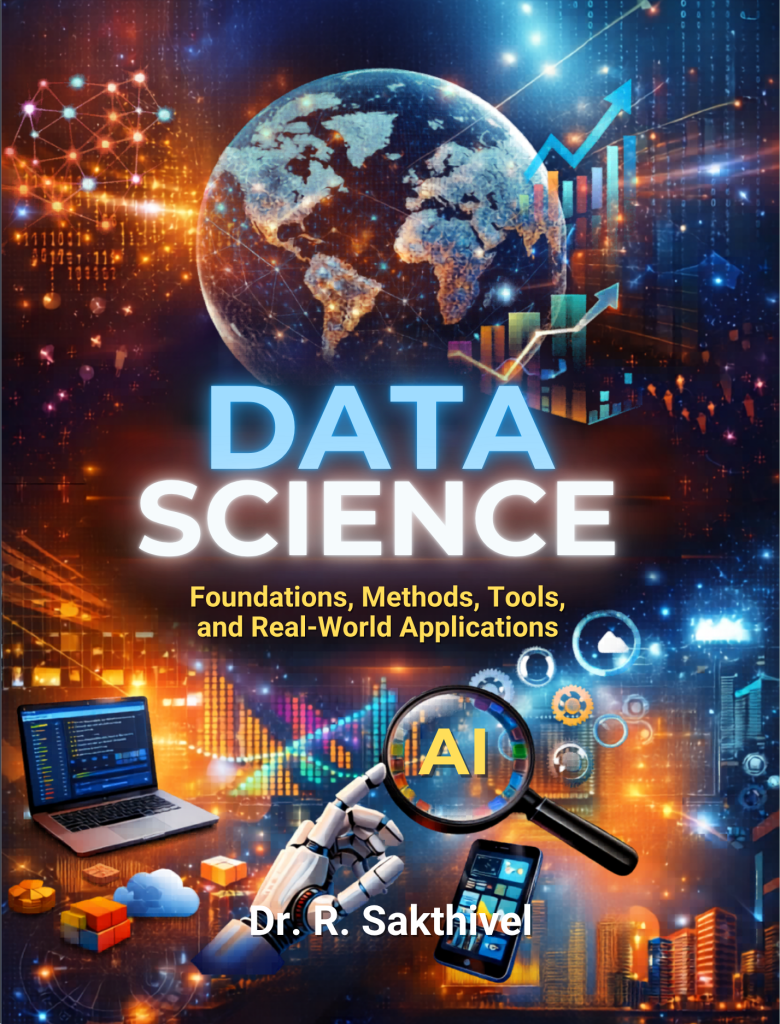
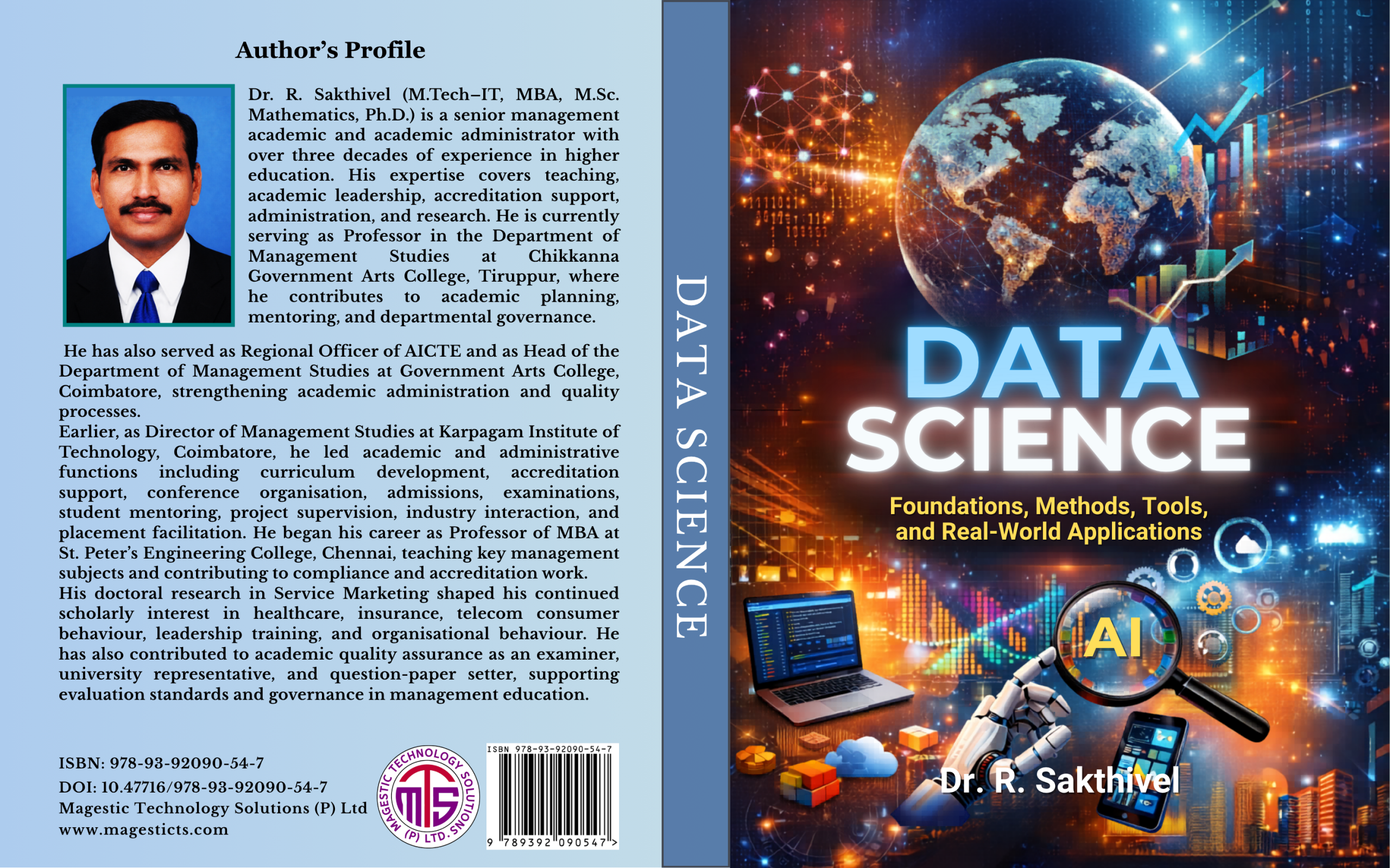
Data Science
Foundations, Methods, Tools, and Real-World Applications is a comprehensive academic and practical guide by Dr. R. Sakthivel, published by Magestic Technology Solutions (P) Ltd.
Foundations. Methods. Tools. Applications.
A polished publication webpage for a modern data science textbook.
Good data science is not only about models; it is about asking the right question, using trustworthy data, and communicating results with clarity.— Dr. R. Sakthivel
A complete guide from foundations to real-world data science practice.
This book introduces data science as an interdisciplinary field combining statistical reasoning, mathematical foundations, computation, programming, and domain understanding to support analysis, prediction, and decision-making.
Book Overview
The text progresses from foundational topics such as data types, analytical thinking, linear algebra, calculus, probability, and statistics to applied areas including Python programming, data preparation, exploratory data analysis, visualization, data wrangling, databases, SQL, and machine learning.
Purpose
The book is designed for students, instructors, self-learners, and early-career professionals who need both conceptual clarity and practical orientation. It emphasizes workflows, interpretation, communication, governance, and responsible practice.
Application Scope
Real-world applications include healthcare, finance, marketing, e-commerce, manufacturing, social media, government, and public policy, supported by case studies and project-oriented discussions.
Learning Philosophy
The book treats data science as a disciplined practice rather than a collection of isolated tools. It encourages readers to ask better questions, examine data carefully, choose methods thoughtfully, evaluate results honestly, and communicate findings responsibly.
Complete bibliographic and publishing information.
These details can be used for academic catalogues, publisher pages, institutional listings, library records, and promotional materials.
International-level academic and professional positioning.
Foundational Clarity
Explains data types, decision-making, statistics, probability, mathematics, and analytical reasoning before moving into advanced tools.
Practical Data Tools
Covers Python, NumPy, pandas, visualization, SQL, databases, data wrangling, data preparation, and real analytical workflows.
Machine Learning and AI
Introduces supervised learning, regression, classification, unsupervised learning, model evaluation, deep learning, generative AI, and edge AI.
Evaluation Discipline
Emphasizes baselines, validation, cross-validation, model selection, error analysis, assumptions, interpretation, and honest reporting.
Ethics and Governance
Addresses privacy, security, algorithmic bias, fairness, accountability, explainability, responsible AI, and governance.
Career Readiness
Includes career paths, data science roles, portfolio building, certifications, learning pathways, interview preparation, and future trends.
Twenty-four chapters covering the full data science learning journey.
The structure progresses from basic concepts and foundations to modern AI, deep learning, responsible data science, applied case studies, career paths, and future directions.
Introduction to Data Science
Data science definition, evolution, lifecycle, roles, applications, challenges, and limitations.
Fundamentals of Data and Decision Making
Types of data, data sources, data-driven decisions, business problems, metrics, KPIs, and insights.
Mathematics for Data Science
Linear algebra, vectors, matrices, calculus, derivatives, optimization, probability, distributions, and Bayes’ theorem.
Statistics for Data Science
Descriptive statistics, central tendency, dispersion, normality, sampling, hypothesis testing, correlation, covariance, and confidence intervals.
Programming for Data Science
Python, variables, data types, operators, control flow, functions, modules, NumPy, pandas, and reproducible code.
Data Collection and Data Preparation
Data acquisition, files, databases, APIs, web data, cleaning, missing values, duplicates, outliers, transformation, encoding, and integration.
Exploratory Data Analysis
EDA objectives, univariate, bivariate, and multivariate analysis, patterns, trends, anomalies, tools, and techniques.
Data Visualization
Effective visual communication, chart types, visualization selection, distributions, relationships, dashboards, and storytelling with data.
Data Wrangling with Pandas
DataFrames, importing, exporting, selecting, filtering, grouping, aggregation, merging, joining, reshaping, dates, and workflow.
Databases and SQL for Data Science
Relational databases, SQL basics, SELECT, WHERE, ORDER BY, GROUP BY, JOIN, subqueries, views, and SQL in projects.
Introduction to Machine Learning
Supervised, unsupervised, and reinforcement learning, training, validation, testing, overfitting, underfitting, and bias-variance trade-off.
Supervised Learning: Regression
Regression concepts, linear regression, multiple regression, assumptions, evaluation metrics, regularization, and applications.
Supervised Learning: Classification
Classification, logistic regression, decision trees, random forests, SVM, k-nearest neighbors, metrics, confusion matrix, F1, ROC, and AUC.
Unsupervised Learning
Clustering, k-means, hierarchical clustering, dimensionality reduction, PCA, association rule learning, and applications.
Model Evaluation and Model Selection
Training and test performance, cross-validation, hyperparameter tuning, grid search, random search, error analysis, and model selection.
Feature Engineering
Feature creation, transformation, scaling, categorical encoding, feature selection, and domain knowledge.
Time Series Analysis
Time series data, trend, seasonality, noise, visualization, forecasting, moving averages, ARIMA, and business applications.
Big Data and Modern Data Science Tools
Big data characteristics, distributed computing, Hadoop, Spark, cloud platforms, and the modern data science tool ecosystem.
Deep Learning Basics
Neural networks, activation functions, forward propagation, backpropagation, training, applications, and limitations.
Ethics, Bias, and Responsible Data Science
Ethics, privacy, security, algorithmic bias, fairness, accountability, transparency, explainability, responsible AI, and governance.
Data Science in Real-World Applications
Applications in healthcare, finance, marketing, e-commerce, manufacturing, social media, government, and public policy.
Case Studies and End-to-End Projects
Customer churn prediction, sales forecasting, credit risk analysis, market basket analysis, project lessons, and common pitfalls.
Career Paths in Data Science
Roles, required skills, portfolio building, certifications, learning pathways, interview preparation, and future career trends.
The Future of Data Science
Emerging trends, automated machine learning, generative AI, edge AI, real-time analytics, human-in-the-loop systems, and the next decade.
Flexible for students, instructors, professionals, and self-learners.
Students
Read sequentially from early chapters to advanced topics, building conceptual and practical knowledge step by step.
Instructors
Use the structure for lectures, tutorials, assignments, projects, classroom discussions, and applied teaching.
Self-Learners
Study one chapter at a time, take notes, reproduce workflows, practice examples, and review summaries.
Professionals
Use selected chapters as a reference for analytics, data wrangling, SQL, machine learning, ethics, and applications.
Dr. R. Sakthivel
M.Tech–IT, MBA, M.Sc. Mathematics, Ph.D.
- Senior management academic and academic administrator.
- More than three decades of experience in higher education.
- Professor, Department of Management Studies, Chikkanna Government Arts College, Tiruppur.
- Former Regional Officer of AICTE.
- Former Head of Department, Government Arts College, Coimbatore.
- Former Director of Management Studies, Karpagam Institute of Technology, Coimbatore.
Academic and Professional Contributions
Dr. R. Sakthivel has contributed to teaching, institutional leadership, accreditation support, academic governance, curriculum development, examinations, admissions, student mentoring, project supervision, industry interaction, and placement facilitation.
His doctoral research in Service Marketing has shaped his continued scholarly interest in healthcare, insurance, telecom consumer behaviour, leadership training, and organisational behaviour.
He has also contributed to academic quality assurance as an examiner, university representative, and question-paper setter, supporting evaluation standards and governance in management education.
Over three decades in higher education.
Service Marketing and organisational behaviour.
Teaching, mentoring, governance, and administration.
Academic leadership, research, and institutional excellence.
Magestic Technology Solutions (P) Ltd
Publisher and editorial contact information for catalogue, institutional, and reader communication.
Publishing House
Editorial Contacts
Download the partial book PDF.
Access the sample / partial published book PDF directly. No embedded PDF preview is used, so the website header and footer will not appear inside this section.
This book supports analytical thinking, responsible practice, and professional readiness in the modern data-driven world.— Data Science: Foundations, Methods, Tools, and Real-World Applications