
Digital Adolescence : Internet Addiction, Parenting and Mental Health
Home » Digital Adolescence : Internet Addiction, Parenting and Mental Health
MTSPL
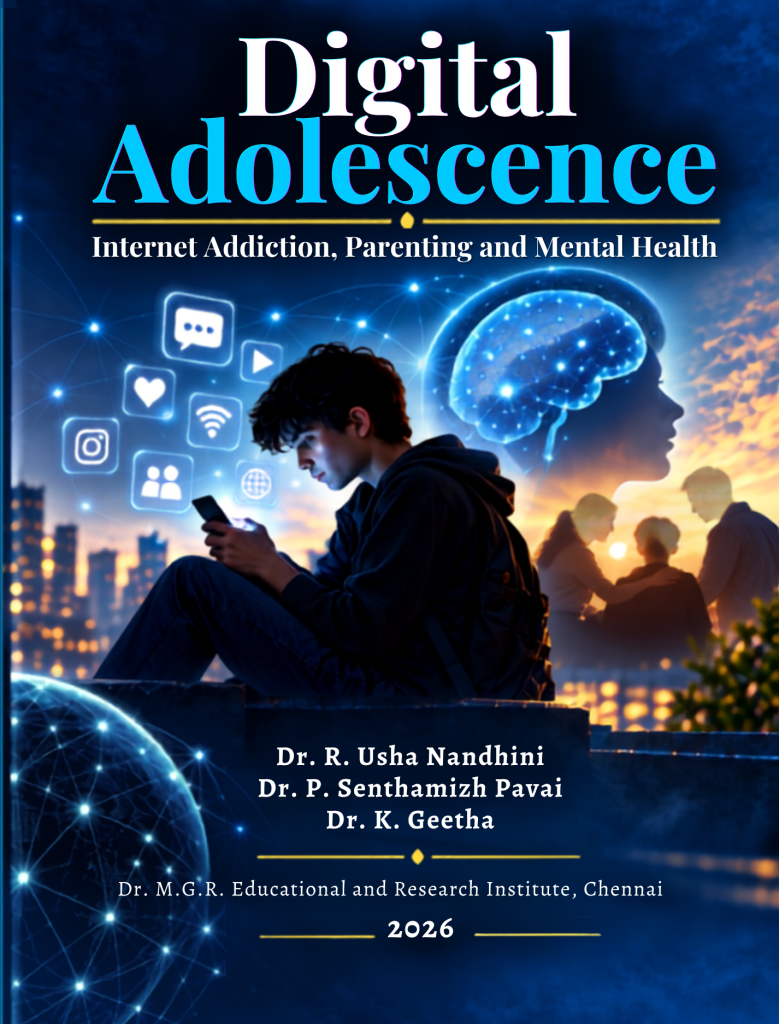
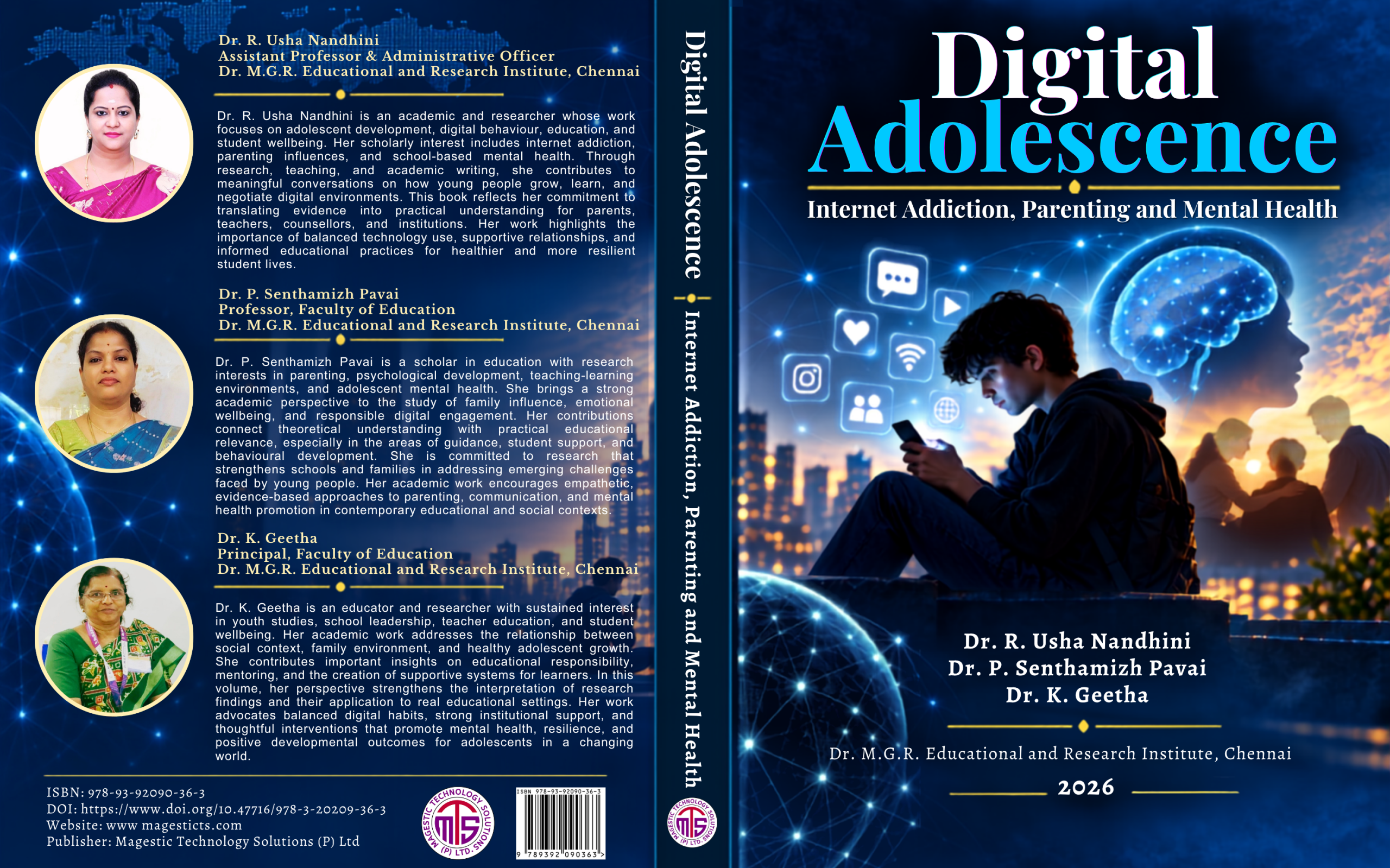
Digital Adolescence : Internet Addiction, Parenting and Mental Health
Authors:
Dr. R. Usha Nandhini
Dr. P. Senthamizh Pavai
Dr. K. Geetha
Publication Date:
14 – 09 – 2026
No. of Pages: 252
Price: ₹ 400/-
ISBN:
978-93-92090-36-3
DOI:
Publisher:
Magestic Technology Solutions (P) Ltd.
Place of Publication:
Digital Adolescence
A research-informed exploration of how internet use, parenting practices and mental health intersect during adolescence, combining empirical evidence with practical guidance for families, educators, counsellors, researchers and institutions.
A Research-Informed Guide to Healthier Digital Lives
Digital Adolescence: Internet Addiction, Parenting and Mental Health examines how digital behaviour, family relationships and psychological well-being interact during one of the most important developmental stages of life.
The book moves beyond the simple question of how many hours an adolescent spends online. Instead, it examines why young people use digital technology, whether they are able to control their use, what activities may be displaced by excessive engagement, how parenting practices influence digital behaviour, and how these factors relate to mental health.
Healthy digital participation is presented as a matter of purpose, balance, self-regulation, safety, adequate sleep, learning, meaningful relationships and the ability to disengage. Problematic internet use becomes a concern when online behaviour becomes difficult to control or repeatedly interferes with education, family life, social participation, physical health or emotional well-being.
Evidence Base and Academic Focus
The empirical foundation of the book comes from a study of 1,000 XI standard students from ten schools in Thiruvallur district, Tamil Nadu. The investigation examined internet addiction, perceived parenting style and mental health together with selected personal, educational, family and socio-economic characteristics.
The analysis draws on descriptive statistics, group comparisons, regression analysis, discriminant analysis and structural equation modelling. The research findings are interpreted cautiously, with particular attention to the distinction between statistical association, prediction and causation.
Internet Use
Patterns of access, online behaviour, excessive use, loss of control, digital habits and the distinction between productive engagement and problematic use.
Parenting
Parenting styles, parental attitudes, communication, boundaries, autonomy, family interaction and their relationship with adolescent behaviour.
Mental Health
Emotional, social and psychological well-being, differences among student groups and the pathways associated with adolescent mental-health outcomes.
Education
Digital transformation of education, school environments, learning practices, student support and the responsibility of educational institutions.
Research Evidence
Indian and international literature, quantitative analysis, regression, discriminant analysis and structural equation modelling.
Digital Well-Being
Practical recommendations relating to digital literacy, family media practices, counselling, sleep, physical activity and healthy offline engagement.
Complete Book Details
| Title | Digital Adolescence |
|---|---|
| Subtitle | Internet Addiction, Parenting and Mental Health |
| Authors |
Dr. R. Usha Nandhini; Dr. P. Senthamizh Pavai; Dr. K. Geetha |
| Institution | Dr. M.G.R. Educational and Research Institute, Chennai, Tamil Nadu, India |
| Book Type | Research Monograph / Academic Book |
| Language | English |
| Edition | Print Edition |
| ISBN | 978-93-92090-36-3 |
| DOI | https://www.doi.org/10.47716/978-93-92090-36-3 |
| Total Pages | 252 |
| Published | 14 September 2026 |
| Price | INR 400 |
| Publisher | Magestic Technology Solutions Private Limited |
| Place of Publication | Chennai, Tamil Nadu, India |
| ISBN Reference No. | 10095|ISBN|2021|P |
| ISBN Issuing Authority | Indian ISBN Agency (RRRNA) |
Who Should Read This Book?
- Parents and caregivers seeking practical approaches to digital boundaries while preserving trust and communication.
- Teachers and teacher educators interested in digital well-being, adolescent behaviour and supportive classroom practices.
- School leaders and administrators developing institutional approaches to responsible technology use and student support.
- Counsellors and psychologists examining the relationship between online behaviour, family experience and mental health.
- Researchers and postgraduate students working in education, psychology, adolescent development, parenting and technology use.
- Students and youth advocates seeking evidence-based ways of understanding digital habits without stigma or simplistic labels.
- Policy-makers and community organisations concerned with digital literacy, mental-health promotion and adolescent well-being.
Chapter-Wise Contents
The book progresses from the broader context of adolescent digital life to empirical analysis and finally to practical strategies for building healthier digital environments.
Growing Up Online
Examines adolescence in a connected world, the digital transformation of education, online opportunities, emerging risks and the importance of digital balance.
What the Evidence Shows
Synthesises Indian and international research concerning internet addiction, parenting styles, adolescent mental health and relationships among these domains.
How the Study Was Built
Presents the research questions, variables, instruments, pilot work, sample, data-collection procedures and statistical strategy used in the Thiruvallur study.
What the Data Show
Presents reliability evidence, descriptive findings, regression results, discriminant analysis, group comparisons and structural modelling.
From Findings to Action
Consolidates the principal findings and develops educational implications and recommendations for teachers, parents, administrators and students.
What Research Tells Us
Reviews Indian and international evidence, identifies areas of agreement and debate and highlights gaps in existing knowledge.
Evidence from the Thiruvallur Study
Explains the study setting, population, school selection, sample of 1,000 students, measurement instruments, validation and analytical approach.
The Digital Lives of Students
Describes smartphone and device access, time spent online, educational and recreational use, social media, gaming, parenting patterns and mental-health patterns.
What Shapes Adolescent Mental Health?
Examines internet addiction and parenting style as predictors of mental health and interprets the dimensions contributing to adolescent well-being.
Differences Across Students, Families and Schools
Investigates differences associated with gender, locality, school type, academic stream, medium of instruction, family characteristics and socio-economic status.
Mapping the Pathways to Mental Health
Integrates key relationships using regression, discriminant analysis and structural equation modelling to present a broader adolescent mental-health pathway.
Building Digital Well-Being
Translates research evidence into practical guidance for parents, teachers, students, school leaders, counsellors and policy-makers.
Building Digital Well-Being
The final part of the book emphasises that healthier digital behaviour requires coordinated action rather than prohibition alone. It places particular importance on informed routines, communication, early identification of difficulties and responsible adult modelling.
- Purposeful and balanced technology use
- Digital literacy and responsible internet behaviour
- Realistic screen-time boundaries and family media plans
- Supportive parenting and age-appropriate autonomy
- Healthy sleep and daily routines
- Physical activity and meaningful offline engagement
- Counselling and early intervention where required
- Stronger family-school partnerships
- Digitally healthy school environments
- Shared responsibility for adolescent well-being
Authors
Dr. R. Usha Nandhini
Dr. M.G.R. Educational and Research Institute, Chennai
Dr. R. Usha Nandhini is an academic, educator, researcher and academic administrator with 17 years of teaching experience, including 12 years in higher education and five years in school education.
She holds a Ph.D. in Education and is UGC-NET qualified. Her additional qualifications include M.Ed., M.Sc. in Computer Science and MBA in Human Resource Management.
Her multidisciplinary academic interests span education, computer science and human resource management. She has published research papers and book chapters and has contributed as a reviewer to scholarly journals.
Dr. P. Senthamizh Pavai
Dr. M.G.R. Educational and Research Institute, Chennai
Dr. P. Senthamizh Pavai is an educationist, teacher educator, researcher and academic leader with extensive experience in teacher education.
She holds M.Sc. in Chemistry, M.Ed., Ph.D. in Education, M.Sc. in Psychology and M.A. in Sociology and has qualified NET in Education, TET Paper II and TRB.
Her expertise includes teacher education, developmental psychology, research methodology and physical science. She has published extensively, guided research scholars and contributed to institutional quality and Sustainable Development Goal initiatives.
Dr. K. Geetha
Dr. M.G.R. Educational and Research Institute, Chennai
Dr. K. Geetha is an educationist, teacher educator, researcher, academic administrator and educational leader with more than three decades of experience.
She holds a Ph.D. in Education, M.Ed., M.Phil. in Economics, M.A. in Economics, M.A. in English and a Postgraduate Diploma in Geography.
Her academic contributions extend across teacher education, educational leadership, student development, emotional intelligence, soft skills, assessment, research supervision and educational technology.
Keywords
Suggested Citation
Suggested Book Citation
Usha Nandhini, R., Senthamizh Pavai, P., & Geetha, K. (2026). Digital Adolescence: Internet Addiction, Parenting and Mental Health. Chennai: Magestic Technology Solutions (P) Ltd. ISBN: 978-93-92090-36-3. DOI: https://www.doi.org/10.47716/978-93-92090-36-3
Rights and Permissions
© 2026 Magestic Technology Solutions Private Limited. All rights reserved.
No part of this publication may be reproduced, stored in a retrieval system or transmitted in any form or by any means, including electronic, mechanical, photocopying or recording, without prior written permission from the publisher, except for brief quotations used for reviews, research and scholarly reference.
Contact the Publisher
Magestic Technology Solutions Private Limited
#35–46, Kuttiappan Street,
Kellys, Chennai – 600 010,
Tamil Nadu, India
Website: www.magesticts.com
Email:
magesh@magesticts.com
martina@magesticts.com
Telephone:
+91 97909 11374
+91 99625 78190
Published by Magestic Technology Solutions (P) Ltd. · Chennai · 2026